

Rejection Recovery Protocol
What I'm learning about how to recover well after taking emotional risks


When I wrote the manifesto for Softer Skills, I included resilience as one of the essential parts of the human experience that we need to reconnect with and deepen in ourselves.
As relationship woes of all kinds (romantic, platonic, communal, professional, etc.) take center stage, one of the many tensions I’ve observed is not about what people are doing to each other. It’s what people aren’t willing to do or, rather, are too frightened to do.
The fear of asking someone on a date IRL (or even just saying “hello”).
The fear of admitting you want commitment or deeper connection.
The fear of speaking candidly about your feelings or needs.
The fear of promoting yourself for a big opportunity.
The fear of sharing something that’s important to you or that you’re proud of.
The fear of putting too much into someone, lest it be more than what they’re willing to put into you.
Life is full of these major and micro emotional risks. But we don’t talk enough about how to effectively recover when taking a risk results in rejection and not connection. We’re seeing the downstream effects of a society that is operating from emotional burnout after never fully healing from experiences of discouragement, disappointment, and hurt. That kind of thing compounds. Nervous systems everywhere are shot.
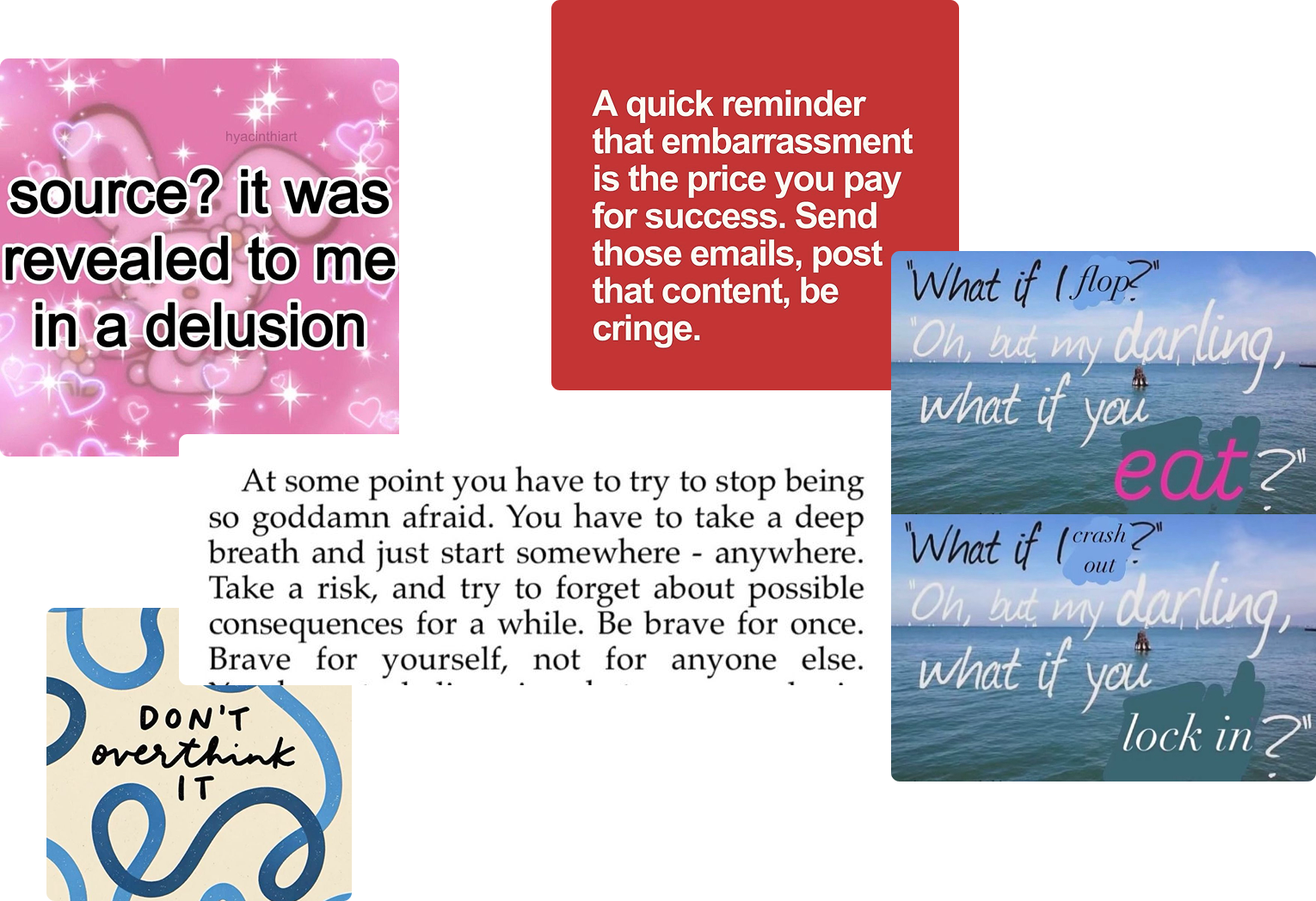
Well-intentioned “delulu” culture persuades people to just take the risks. Stay in that abundance mindset and focus on the potential payoffs! If it doesn’t work? Oh, well. On to the next one.
In reality, for most humans, the moments after a risk actually risks and doesn’t reward is usually not just a ¯\_(ツ)_/¯ and move on with a smile. You know those jokes about our bodies not being evolved enough to tell the difference between being chased by a bear and receiving a “can we talk?” text? It’s like that. The “failure” to connect often feels like you have been kicked to the outskirts of your tribe and left to die.
In the modern age, we may physically survive the moment, maybe even employ some good coping skills to soothe the symptoms, but survival does not mean coming out psychologically unscathed.
Instead of “oh, well” could we address the more realistic “oh, shit” feeling that tears through our minds and bodies instead?
In the days, weeks, months, sometimes years spent in recovery after the initial wound, I worry that we learn to cope, but we don’t actually rehabilitate. The outcome looks more like avoiding taking any future risks altogether by becoming jaded, apprehensive, suspicious, selfish, and detached. That’s our survival instinct kicking in—our subconsciouses trying to protect us from danger by any means necessary, even if that means isolation. A recovery process that starts and stops at survival and does not continue on to repair is what’s making it increasingly hard to tolerate interacting with other humans.
To stop trying to reach for what we truly desire from human relationships is not healing or growth. It’s stagnation.
My hypothesis? The missing component in the recovery process is a resilience practice — a conscious journey back to a state of readiness. Resilience is not a new concept, but I want to zoom in on how it can be applied as a relational skill.
Potential payoffs alone do not make risk-taking a no-brainer. There has to be self-trust. Before you took any social leap, what if you knew that you would be okay no matter what because you have a fallback plan (or should I say bounce back plan)? Wouldn’t it make that jump feel less steep? Wouldn’t you be more willing to go for it? A resilience practice builds that internal faith.

Rejection Recovery Protocol
If emotional risk-taking is such an every day part of our lives, shouldn’t we have more tools to not be psychologically obliterated or emotionally crippled each time something not-so-good happens?
A couple of months ago, I was listening to an episode of the She’s So Lucky podcast with guest Alexis Barber. Alexis spoke about how, after a session with her coach revealed that she was mentally exhausted, she was put on “burnout protocol”. This coach had created a framework that she could deploy with her clients to get through this collapse with more intention rather than frantically trying to just survive it. It entailed tasks like auditing and redistributing workload where possible and trading out the business and self-help podcasts for fiction novels.
After hearing that, this concept of protocols got stuck in my head. We’ve seen things like self-care menus, dopamine menus, etc. — reference guides that are easy to reach for when the moment calls for it.
It got me thinking: what would a “rejection recovery protocol” look like? Something we can reach for to help us process and move through the aftermath of emotional risk with more confidence?
That’s how I arrived here, desperately trying to explain to you the first drafts of this working theory.
We’re not quite at protocol yet, but I have begun to codify different types of resilience strategies, and I thought it was important enough to share. I observed that not all rejection is the same, so not all methods of resilience should be the same either.
These could be used as starting points to define what you actually need. Knowing what kind of down bad you are can help you know what bounce back method you need to apply.
The 5 Resilience Strategies:
Pivoting: Actually coming up with and moving forward with Plan B when Plan A is no longer an option.
Not every rejection means a full 180° redirection away from your desires. Sometimes it just means that particular avenue of getting there wasn’t the right one. Try a different approach.
Defiance: Resisting the urge to let other people’s subjective desires and perspectives become the authority over you and your sense of self.
“I have already settled it for myself so flattery and criticism go down the same drain and I am quite free.” - Georgia O’Keeffe
Endurance: Having the audacity to continue desiring and believing that those actualized desires are always an option, especially when faced with lesser, misaligned, or no opportunities.
This one addresses the unique rejection of nothingness—when things aren’t particularly happening for or against you over long periods of time—and the urge to make meaning out of the absence of success.
Alchemy: Reframing unexpected outcomes to work in your favor.
Think: How can I still make this a win?
Compassion: Having compassion for yourself for being human and imperfect and allowing yourself to move on.
Perfectionism is a jail cell designed to keep us frozen in shame. It’s a different kind of delusion. Grace brings us back to reality and sets us free.
What if the next time rejection happened, you could reference this list, pick a strategy, and feel more firm in that decision? To be able to consciously say, “this hurts really bad, but I’m employing a resilience strategy to move forward,” rather than languishing and letting your subconscious try to fight for your survival (with mixed results)? This is the theory I’m testing and developing.
Disclaimer: this protocol is not designed to save you from pain or create a frictionless social landscape. A resilience practice is the tool you use to scale back up the emotional cliff after diving off it. We have a spectrum of emotions for a reason and we unlock so much more of ourselves in the process of discovering and feeling each one (even the bad ones). Quiet as its kept, you grow quite a bit from these experiences too. But there should be a way to care for ourselves and integrate these experiences into our psyche in a way that actually improves our self-image, incentivizes continued bravery, and strengthens our resolve to live to the fullest.
In reconnecting with your ability to be resilient, how does that change your perspective on or willingness to take emotional risks?

👋🏾 Thank you for reading!
Ruminations is a column dedicated to diving deep into the social phenomena that are shaping how we gather, connect, and navigate relationships in modern society. This is our space to unpack and [over]think for ourselves about what we’re really experiencing.
I invite you to join the conversation and even add to this working theory if you feel so inclined!