

The job of a community member, personal canons, and weekly whims
The Social Times: Issue 003

The Social Times is a weekly snapshot of society and culture from the perspective of a sociologist. You’ll find musings, conversation starters, and reflections about how we’re living and relating to one another.


Bless our collective hearts. We are trying our darndest to make community something that we can see, touch, and feel. I love it.
I’ve been chewing on this sinewy, tendinous hunk of a topic for some time. A rumination is brewing in the background.
Most recently, I’ve been trying to narrow in on what it actually means to create and be in community.
If someone was to build a flourishing community from scratch (as many are trying to do), what ingredients would they need to be successful in those efforts?
In the past 5 years or so, we’ve observed the swelling of what I tentatively call the “third place industry”. I can appreciate it as a sort of first go at solving a modern problem — reviving the social spaces that theoretically existed before the pandemic and that brought us a sense of community and connectedness.
As the industry firms up, sophisticated operating models have emerged. There are private memberships that grant access to swanky clubhouses, faceless event organizers (whose mailing addresses are Instagram handles) that manage to pump out enough themed parties to fill your weekends, and activity-based meetup groups that offer clearly defined lanes for socialization.
They all call themselves communities, but I struggle with the use of this terminology as these groups currently stand. In the process of commercializing social experiences, community has become a product — a pre-made thing that you can buy via subscription or ticket and immediately start reaping the benefits from.
Community, by definition, cannot be one-directional, though. It’s characterized by collectiveness: a sense of shared responsibility (to a space, a set of values and principles, and to each other) and active participation (contribution, presence, involvement). What you put in is what you get out. In “tight-knit” communities, your absence or failure to contribute actually impacts the rest of the group.
In these new-age third places, the absolution of duties and lack of responsibility is often a selling point. In some of the most coveted member clubs, hired chefs cook your meals, there’s an entire staff dedicated to keeping the clubhouse pristine, and a separate team plans and puts on events for the whole club. The work of “creating community” is all done for you. As a member, there’s nothing that you need to contribute to make the experience what it is. Except, of course, your annual dues.
Similarly, if you attend a party hosted by commercial event organizers, there’s no expectation that you come early to help set up, bring a dish or bottle, or even that you’d take a turn planning and hosting an event yourself.
We’ve outsourced to a third party perhaps the most essential cog that makes communities run: the investment of personal time, energy, and resources into something other than yourself.
This is likely why you can enter such “communities” and see the people inside and touch the walls of these spaces but not feel connected to any of it. After all, you did nothing to build it.
This is not to say that community is only real if you’re cooking communal dinners and scrubbing bathroom floors alongside your social clubmates. But not having any anchors to the spaces you are meant to belong can create a culture of carelessness and detachment, which can then break down the fabric of the alleged community. On the same coin of not needing to contribute is not needing to be there at all.
As we continue to evolve modern social environments in the hopes that they become fertile ground for communities to grow, how can we incorporate aspects like roles, responsibilities, and active participation (beyond just showing up or paying your way in) to create a sense of belonging and interconnectedness?

A prompt to spark a conversation with yourself or someone else this week.
If you had to curate a selection of 5 books, 5 movies, and 5 songs to make up your personal canon, what would they be? And this is not just your favorite stuff, I’m talking the things that shaped you or feel core to who you are.

I’m testing a new roundup format for this segment! I was feeling kind of blah about the Culture Digest, which presented a roundup of recent media I’d read, listened to, or watched that could be tied to society and culture. It was great in theory. In practice, putting together a weekly digest ended up feeling like a scramble to sort through and consume media at a volume that I wouldn’t normally consume in a given week. And don’t get me started on the publication paywalls.
While I will still share media that does stick with me, I’m expanding the scope of this section to include other forms of analysis and reflection.
Inspired by the weekly R.E.P.O.R.T, I present to you a new acronym: W.H.I.M.S.
Humor me and use this in your own newsletter, too!
Wondered: Can the judgements we make about others help us better understand our own beliefs and values? The other day, I found myself criticizing a person in my head. Instead of waving these critiques off as intrusive thoughts as I normally would (I fundamentally don’t like to judge), I decided to sit with them instead. What were they highlighting about my internal compass? I noticed that some of the judgements that bubbled up were my mind attempting to re-assert core values in the face of someone that was going against them. Other judgements exposed what I subconsciously rejected about myself or believed I wasn’t allowed to do (in order to be accepted, worthy, successful, etc.). Both revelations were valuable to me — I learned what I would not budge on and got the chance to release beliefs I was holding on to that I actually didn’t agree with upon further inspection.
Heard: Kendra Austin on the She’s So Lucky podcast. Kendra is such a luminary of self-actualization and identity evolution. There are so many gems to this conversation, but I really appreciated her discussion about managing a team and working with a business partner and what it has taught her about trust, flexibility, and the inefficiencies of perfectionism (37:41).
Into: Alternative souvenirs.
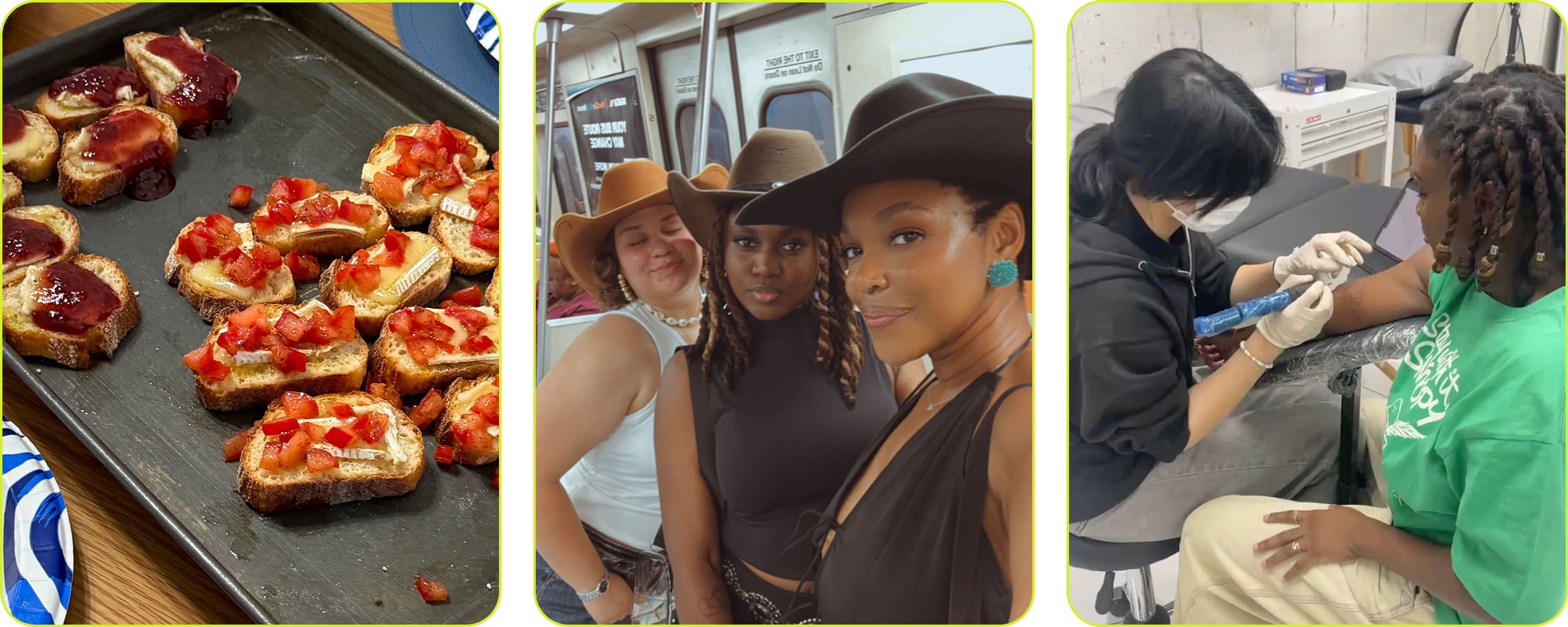
Recipes: I made some bruschetta for a snack when my friend visited, and she recreated the dish at home for her family (and even put her own twist on it with her mom’s homemade jam).
Cowboy Hats: My friends and I got personalized cowboy hats for the Cowboy Carter concert and proceeded to make them our entire personalities.
Tattoos: I got my first tattoo in Paris and have been getting tattoos in different cities and countries since! My most recent tattoo was done in Japan.
Made: A new friend! We met at a pottery class, and on the last day we chatted a bit more and discovered a shared desire to explore more of the city. The next week, we met up for live jazz at a rooftop bar and hit it off. When’s the last time you made a brand new friend — no mutuals or having been previously acquainted?
Spotted: Solo Traveling with Tracee Ellis Ross — a masterclass in emotional spaciousness presented as a vlog-style documentary following Tracee, her 10 suitcases, and her reflections across Morocco, Mexico, and Spain.
“This is me sharing what it means to learn yourself, and then having the courage to be that person.”
I hope this email leaves you well,
Lola

About Softer Skills
Softer Skills is a publication dedicated to studying and discovering better ways to be with ourselves and each other.
oooo I can’t wait to watch Tracee’s doc!
A book, a movie, and a song that are canon for me:
- 📚 Listening for Lions by Gloria Whelan
- 🎞️ The Devil Wears Prada
- 🎧 Holy by Jamila Woods